

Pooja Choudhary
Fintech needs no Introduction due to its global robust demand and accelerated clip. The Fintech space has witnessed a correction in valuation and investment flow globally. Recent regulatory changes had an impact on the operating and revenue model for fintech players. This segment should see an increase in deal flow activity driven by investment flows in wealth tech, insurtech, and M&A of Fintech NBFCs. 2021 was a banner year for the fintech market globally, which makes the first half of 2022 seem slow by comparison. But in reality, many sectors within the fintech market have shown strength and resilience. While the fintech market will likely be quite challenged in 2022 due to global uncertainty and broader economic concerns, fintech will likely continue to attract significant attention and investment.
With valuations going under pressure, fintech financial backers will improve their emphasis on income, income development, and benefit which could make it harder for some fintech to raise funds, M&A activity, could see an increase as battling fintech hope to sell instead of holding a down round, corporate and PE financial backers move to exploit better evaluating, and well-capitalized fintech look to take out the competition. 2022 saw various difficulties influencing the more extensive venture market, including geopolitical uncertainty, turbulence in the public markets, and increasing expansion and loan costs. Seemingly forever to a significant number of these difficulties, the fintech market could see action easing back impressively, especially contrasted with the significant record highs seen in 2021.
Statistics For Global Fintech Investments
- Global investment in fintech falls to $107.8 billion despite robust VC funding.
- While VC investment globally declined from $66.5 billion in 2021 to $52.6 billion in 2022, compared to all periods outside of 2021, the amount was incredibly robust. The Americans accounted for the largest amount of VC funding ($27.2 billion), while EMEA set a new record high for a six-month period ($16.6 billion).
- In 2021, investment in fintech was very remarkable as financial backers rushed to make investments in this area. While speculation has dropped back to levels seen in earlier years, the space is supposed to stay focused for investors in 2022 and into 2023.
- Investment in the payments space remained very strong in 2022, accounting for $43.6 billion in investment compared to the $60.3 billion seen during all of 2021.
- Investment in the insurtech sector dropped considerably, with $3.8 billion of investment globally during 2022 well off pace to match the $14.8 billion in investment seen during 2021.
- Compared to a number of other areas of fintech, global investment in regtech showed strong resilience in 2022. Globally, regtech companies attracted $5.6 billion in investment across 157 deals following a similar trajectory to the level of investment seen in 2021.
- After a very strong 2021, wealthtech investment softened considerably in 2022, mirroring the decline in investment more broadly around the world.
- After a record-shattering 2021, global investment in crypto and blockchain fell to $14.2 billion in 2022.
- The turbulence in the public markets globally had a major impact on the valuations of many public tech companies in 2022, including fintech. This, combined with other challenging market factors, brought IPO activity almost to a halt, a trend expected to continue through 2022.
- B2B solutions will become more attractive to investors: As the world teeters on the edge of a recession, fintech investors will likely enhance their focus on B2B companies working to help companies become more efficient or enable them to expand their value propositions.
Top 10 Global Fintech Deals
- Afterpay $27.9B, Melbourne, Australia (Payments M&A)
- Sia (Milan) $3.9B, Milan, Italy ( Payments M&A)
- Bottomline Technologies $2.6B, Portsmouth, US (B2B Public-to-private buyout)
- Yayoi $2.1B, Tokyo, Japan Institutional/B2B (Corporate divestiture)
- Interactive Investor $1.8B, Leeds, UK (Wealth/investment management M&A)
- FNZ $1.4B, London, UK (Wealth/investment management PE growth)
- SimpleNexus $1.2B, Lehi, US (Lending M&A)
- Trade Republic $1.15B, Berlin, Germany (Capital markets Series C)
- Technisys $1.1B, Miami, US (Institutional/B2B M&A)
- Superhero $1.06B, Sydney, Australia (Wealth/investment management M&A)
Read: Cybersecurity Timeline and Trends You Should Know before Planning for 2023
Top 10 fintech Deals In The Americas In 2022
- Bottomline Technologies — $2.6B, Portsmouth, US — Institutional/B2B —Public-to-private buyout
- SimpleNexus — $1.2B, Lehi, US — Lending — M&A
- Technisys — $1.1B, Miami, US — Institutional/B2B — M&A
- Ramp — $748.3M, New York, US — Institutional/B2B — Series C
- Finxact — $650M, Jacksonville, US — Institutional/B2B — M&A
- Fireblocks — $550M, New York, US — Blockchain/cryptocurrency — Series E
- Forge Global — $532.5M, San Francisco, US — Capital markets — Reverse merger
- Crusoe Energy Systems — $505M, Denver, US — Institutional/B2B — Series C
- FTX — $500M, Nassau, Bahamas — Blockchain/cryptocurrency — Series C
- Liquidity Group — $475M, New York, US — Institutional/B2B — Late-stage VC
Trending Fintech Highlights
During the first half of 2022, various elements consolidated to influence the vertical direction of fintech ventures around the world, including international vulnerability, tempestuous public business sectors, progressing inventory network disturbances and challenges, elevated degrees of inflation, and expanding financing costs. Seemingly forever to the degrees of uncertainty, fintech investment in 2022 could be very quelled, especially contrasted with the huge record highs experienced in 2021. The graphics below shall give a clear overview in regard to the same.
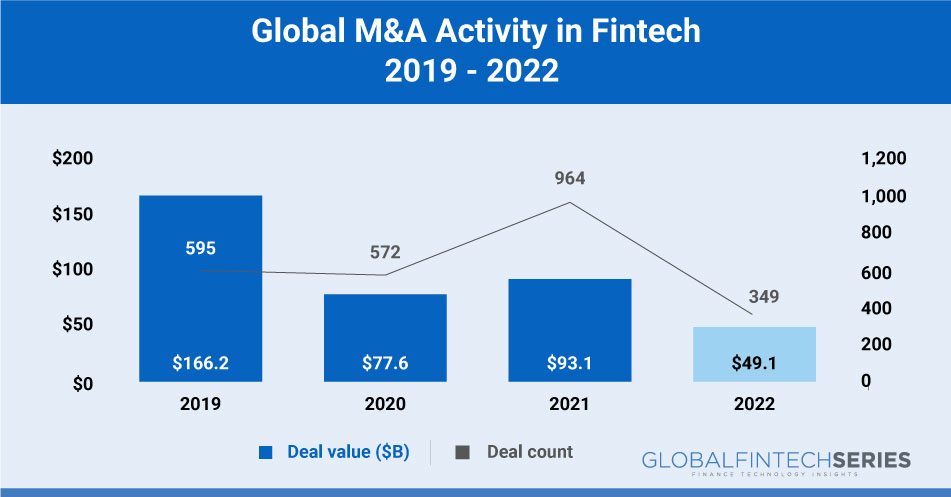
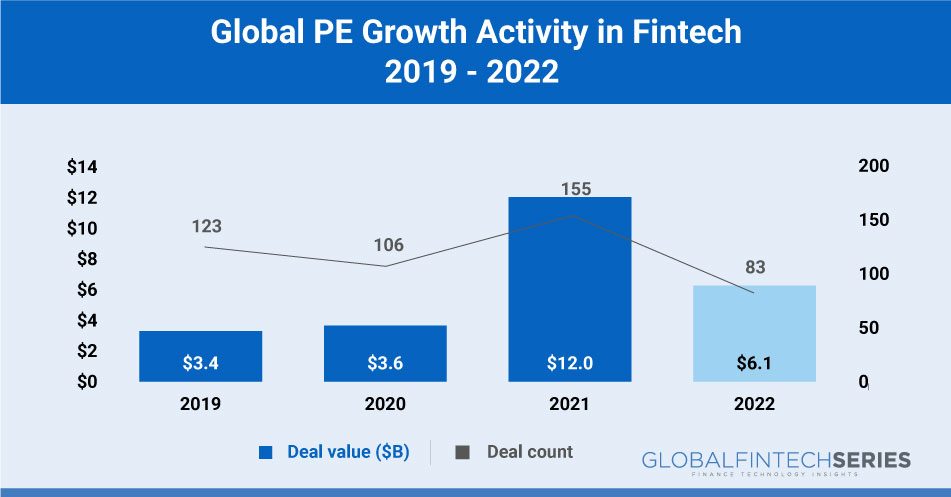
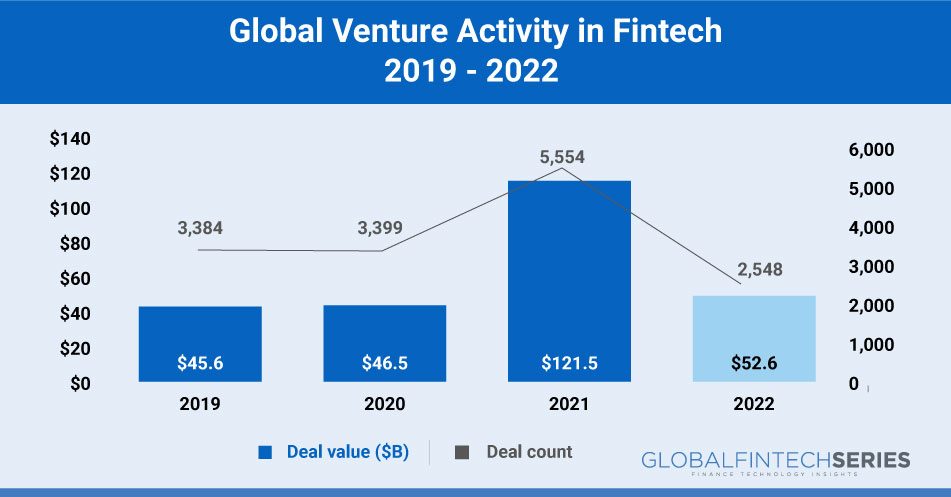
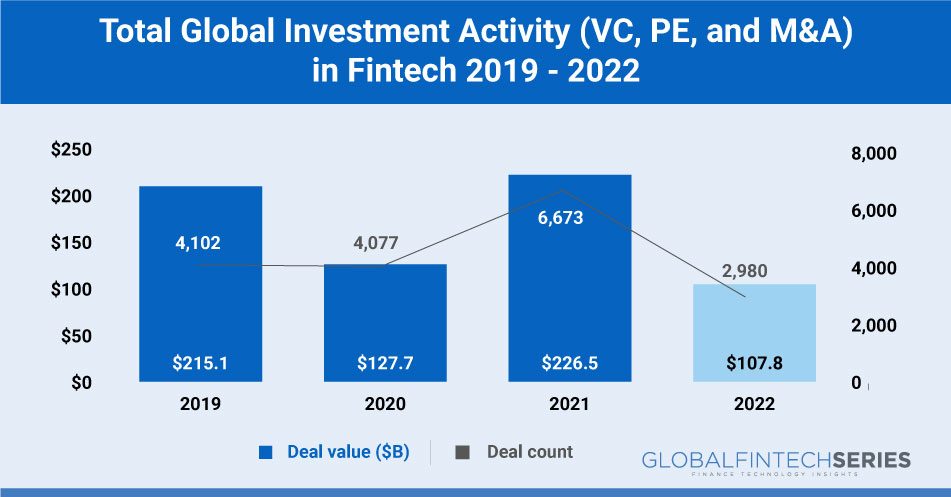
Global fintech investments in 2022 recorded $107.8B with 2,980 deals. Investors in all key jurisdictions continued to flock to the payments space in 2022, investing $43.6 billion in payments-focused companies. Given the increasing macroeconomic challenges, investment in the payments space could taper off a bit heading into 2022, particularly with respect to early-stage deals.
M&A activity is expected to remain strong as a result of increasing consolidation among payments firms and as the number and size of the add-in, transactions rise. While the crypto space experienced significant challenges during the first half of 2022, crypto-focused companies attracted $14.2 billion during 2022. Going forward, we could see B2B solutions aimed at the improvement of infrastructure or the optimization of operational activities like AR/AP and a continued focus on embedded solutions, including payments, finance, and insurance.
Read: Invest Money Wisely In 2023 – Know The Best Ways To Invest In Cryptocurrency
Fintech Interface for the United States
The Americas pulled in $39.4 billion in fintech interest in 2022, down from $59.7 billion in 2021 Notwithstanding a plunge in quarterly investment to $22.7 billion, the Americas saw a record 806 deals in Q1 ’22, featuring the strength of the fintech market in the region toward the beginning of 2022. As international vulnerability and macroeconomic difficulties expanded towards, fintech, financial investors pulled back fairly. Total investment dropped to $16.8 billion across 624 deals in Q2’22, bringing the venture complete to $39.4 billion across 1,430 deals for the principal half of the year. The US represented the biggest arrangements in the Americas during 2022, including the $2.6 billion buyout of Bottomline Advances by PE firm Thomas Bravo, the $1.2 billion buyout of SimpleNexus by nCino, the $1.1 billion procurement of Technisys by SoFi, and the $748 million VC raise by Ramp.
The US draws in by far most of the fintech investment in the Americas: The US represented $34.9 billion of fintech investment in the Americas during 2022, a drop from $49.7 billion in 2022. Fintech speculation beyond the US dropped considerably more enormously following the fast ascent in worldwide international and macroeconomic vulnerability with Brazil and Canada seeing decreases in venture more prominent than 50% somewhere in the range of 2021 and 2022. Brazil saw fintech investment drop from $3.7 billion to $1.4 billion, while Canada saw investment tumble from $1.9 billion to $810 million. Investors turning focus to profitability and cash flow: Given rising interest rates, increasing levels of inflation, and growing concerns about an economic recession, fintech investors across the Americas enhanced their focus on profitability, top-line revenue growth, and cash flow when evaluating targets and companies within their portfolios. Financial Investors have likewise begun to consider the capability of organizations to convey returns given the changing market conditions. Declining valuations in numerous fintech subsectors: Given macroeconomic circumstances, numerous public organizations have seen huge descending tension in their valuations, including numerous tech organizations.
While the private markets have not seen changes in accordance with a similar degree at this point, there could be various down round heading into 2022 as fintech hope to raise capital given the descending strain on valuations. Interest in the challenger bank market remains quite strong Within the Americas, challenger banks continued to attract attention, particularly in Latin America, where challenger banks are focusing on middle market consumers and small businesses large populations seen as underserved historically. Interest in challenger banks is also growing in Canada, where the banking market has long been dominated by a small number of big banks. Following a record-breaking year of crypto and blockchain investment in the Americas in 2021, investment in the space eased back during 2022. While speculation remained areas of strength for exceptionally to pre-2021 outcomes, driven by January raises by US-based Fireblocks ($550 million) and Bahamas-based FTX, 2022 could introduce more difficulties for organizations in the area.
Read: Did You Know- 14 Bitcoin Facts
Suggestions For Fintech Investments
- Valuations continue to adjust as the cost of capital increases: As interest rates continue to rise, capital will become more expensive. This will have an impact on valuations and will drive investors to enhance their focus on cash flow, top-line revenue growth, and profitability
- M&A will increase as corporates and PE firms look for bargains: Given the downward pressure on valuations, M&A activity will likely increase as investors see the opportunity to make acquisitions at better prices than have been seen in recent years. Startups could also look to sell as an alternative to holding a down round.
- Interest in cybersecurity automation will keep growing: With cybersecurity concerns only growing on the radar of most companies, there will likely be an increasing focus on cybersecurity automation as a means to improve cybersecurity management while also managing talent shortages and improving operating efficiencies.
- B2B solutions will become more attractive to investors: As the world teeters on the edge of a recession, fintech investors will likely enhance their focus on B2B companies working to help companies become more efficient or enable them to expand their value propositions.
- Fintech Will continue to focus on data-driven solutions: Fintech companies will continue to focus on finding unique ways to collect, assess, and utilize data in order to differentiate their offerings — in the eyes of both corporates and consumers.
- Crypto and blockchain investments will increasingly focus on infrastructure: While investing in cryptocurrencies is expected to slow down further, there will likely be a continued focus on the use of blockchain in financial market modernization.
The Bottom Line
Fintech makes money in different ways depending on its specialty. Banking fintech, for example, may generate revenue from fees, loan interest, and selling financial products. Investment apps may charge brokerage fees, utilize payment for order flow (PfOF), or collect a percentage of assets under management (AUM). Payments apps may earn interest on cash amounts and charge for features like earlier withdrawals or credit card use. While fintech investment is expected to remain somewhat resilient, particularly in areas like B2B payments, cybersecurity automation, and data-driven analytics.
Read latest article: What Is Data Science?
[To share your insights with us, please write to sghosh@martechseries.com]

