

Pooja Choudhary
With smart applications and a semantic web with individual focus and consolidated content this Web 3.0, the third-generation internet is the next evolution of the World Wide Web coined in 2014. We can future-proof entrepreneurial & investment activities by virtually eradicating the platform dependency risks we observe today. Let’s discuss further what exactly is Web 3.0, how it was coined, what the technologies related to it, and its future outlook.
Web 3.0 Tech In Depth
It provides a data-driven Semantic Web employing a machine-based understanding with the objective of developing a more intelligent and connected web experience for its users. Today’s Web is quite static and is unable to adjust to individual requirements while Web 3.0 promises to be dynamic. By implementing artificial intelligence (AI) and blockchain technology the web experiences structural changes to ensure democratization across all aspects of the internet. In Web 3.0, data is stored securely and distributed across devices thereby removing the need for centralized servers. Such a design also reduces the risk of massive data leaks because data is no longer centrally stored making it resilient to compromise. Since it remains a collection of ideas more than anything else, it’s challenging to nail down a perfect definition for it but for cryptocurrency developers it incorporates the technologies and concepts that are at the heart of crypto, decentralization, token-based economies, and blockchain. Assuming that the number of ventures and the going buzz are thought of, Web 3.0 is obviously the eventual fate of the web. The graphics below shall give you a better insight into the Web3.0 market and its key players along with a segment overview.
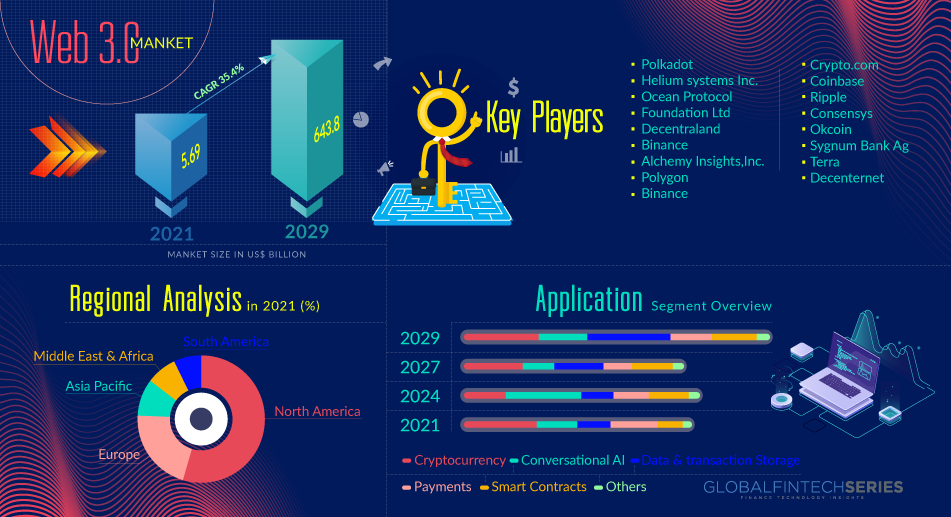
This vision will in general be a more just rendition of the present web-based world. It’s based on the possibility of proprietorship, eliminating control from the prevailing large information organizations and other focal specialists and giving it to the majority. Decentralization implies web clients can execute business shared, removing go-betweens and eliminating power from controlling elements. There is a more noteworthy spotlight on client protection, straightforwardness, and ownership. Here’s where blockchain innovation and digital currency come into the equation. Despite cases of democratization made by some crypto projects, with token holders having the option to take part in administration, a generally held analysis of Web 3.0 is that control is concentrated among financial speculators and early adopters.
How Large Is The Market Of Web 3.0?
The global Web 3.0 market size reached $3.2 Billion in 2021 and is expected to register a Compound Annual Growth Rate (CAGR) of 43.7% to reach a whopping $81.5 Billion by 2030. To understand how much web data is being generated consider that consumer IP traffic will grow three-fold from 2017 to 2022 at a compound annual growth rate of 27%. Globally, consumer IP traffic will reach 332.7 EB per month by 2022. In 2020 alone,2.5 quintillion bytes of data were generated daily, and 40% of that was machine-generated. By 2025, there will be 152,200 IoT devices connecting to the internet per minute. Polkadot (DOT) is the #1 Web3 token in terms of market capitalization, currently sitting at $17.48 billion. The second-highest is Chainlink (LINK), valued at $6.54 billion, followed by Filecoin (FIL) and Theta Network (THETA).
Recommended: Demystifying AR/VR Technology In Healthcare Domain
Web3 Technologies Deployed
- DeFi: Decentralized Finance.DeFi plans to reform fintech in this manner eliminating the requirement for focal specialists, for example, banks, installment processors, and different delegates, in their place would be a shared monetary framework that lives on the blockchain, and a large portion of administrations banks and other monetary middle people proposition can be accomplished through DeFi. This incorporates bank stores, loaning and getting, resource exchanging, and protection, among others. Examples are Uniswap (UNI), Aave (AAVE), and Chainlink (Connection), which are intended to complete monetary exchanges.
- NFTs: Non-Fungible Tokens. These are a class of computerized resources that live on the blockchain. Each NFT is remarkable (non-fungible), and no two NFTs are indistinguishable. This is rather than monetary standards which are fungible. As the crypto market sped up moon wards in 2021, multimillion-dollar deals of computerized craftsmanship NFTs were the same old thing. NFTs could change various parts of our day-to-day routines, for example, sealed ID, and show pass deals despite the fact that they are a piece speculative. Many sorts of exchanged digital currencies support NFTs on their blockchains. A few examples are Ethereum (ETH), Solana (SOL), and Torrential slide (AVAX).
- DAOs: Decentralised Autonomous Organizations. It is a group formed for a common purpose with its guidelines, plans and goals generally encoded on the blockchain. DAO has no hierarchy, no bureaucracy, and no red tape. Most usually they work in light of a majority rule structure, where votes are projected in association with the number of crypto tokens clients hold. What makes a DAO appealing to numerous clients is that all monetary exchanges are recorded on a blockchain, which eliminates any third-party involvement.
Birth Of Web 3.0
Futurists say that Internet 3.0 will turn into a fundamental piece of the always-growing advancement of the web. Assuming this vision happens, it could open the speculative potential for financial backers and developers. If you have confidence in the vision representing things to come, purchasing digital currency is a simple method for acquiring exposure to Web3. You can buy cryptocurrencies that help DAOs and DeFi conventions or buy digital art in the form of NFTs.
While the Internet 2.0 wave is as yet proving to be fruitful, we are additionally seeing the principal shoots of development rise up out of the following huge change in perspective in web applications, legitimately entitled Web 3.0. As difficult to accept as it could appear, Web 3.0 is a much more key disturbance, one that in time will leave everything up until recently in its shade. It is a jump forward to open, trustless, and permissionless networks. The extreme result of these new open, trustless, and permissionless organizations is the likelihood to facilitate and boost the long tail of work, administration, information, and content suppliers that are the disappointing scenery to a significant number of the universes most intense difficulties, for example, wellbeing, food, finance, and sustainability. Where Web 2.0 was driven by the appearance of portable, social, and cloud, Web 3.0 is fabricated generally on three new layers of mechanical development: edge processing, decentralized information organizations, and man-made reasoning. While in Web 2.0 as of late commoditized PC equipment was reused in server farms, the shift to Web 3.0 is spreading the server farm out to the edge, and frequently squarely into our hands. Enormous heritage server farms are being enhanced by a huge number of strong figuring assets spread across telephones, PCs, machines, sensors, and vehicles which are estimated to deliver and consume multiple times more information in 2025 when contrasted with 2010. With Web 3.0, ladies, men, machines, and organizations will actually want to exchange esteem, and data and work with worldwide counter gatherings they don’t have the foggiest idea or yet unequivocally trust, without a mediator. The main development empowered by Web 3.0 is the minimization of the trust expected for coordination on a worldwide scale. This denotes a move towards confiding in all constituents of an organization verifiably as opposed to expecting to trust every individual unequivocally and trying to extraneously accomplish trust.
8 Wings Of Web 3.0 Which Makes It Possible To Fly
- Semantic Web: The next evolution of the Web involves the Semantic Web. The Semantic Web improves the abilities of web technologies to generate, share and connect content through search and analysis by understanding the meaning of words rather than by keywords or numbers.
- Artificial Intelligence: By combining semantic capabilities with natural language processing, computers can understand information on a human-like level to provide faster and more relevant results. In doing so, they become more intelligent and better satisfy the needs of users.
- 3D Graphics: Three-dimensional design is used extensively in websites and services in Web 3.0. Museum guides, computer games, eCommerce, geospatial contexts, and more are all common examples of this.
- Connectivity: With Web 3.0, information is more connected thanks to semantic metadata. As a result, the user experience evolves into a new level of connectivity that leverages all available information.
- Ubiquity: Internet content and services can be accessed anywhere at any time via any number of devices, rather than exclusively via computers and smartphones. Web 2.0 is already ubiquitous in many ways, but the growth of IoT devices will take it to new levels.
- Blockchain: With blockchain technology, user data is protected and encrypted. This prevents large companies from controlling and/or using users’ personal data for their gain.
- Decentralized: Decentralized data networks store data within a peer-to-peer interconnection. Users maintain ownership over their data and digital assets and are able to log in securely over the internet without being tracked.
- Edge Computing: Web 3.0 relies on the advance of edge computing in which apps and data are processed at the network edge on devices such as mobile phones, laptops, appliances, sensors, and even smart cars.
Read: Did You Know- 14 Bitcoin Facts
How Web 3.0 Can Change Our Lives
In a new study of 4400+ US grown-ups, respondents were inquired as to whether they knew about the term Web3. Turns out that 62% of the people who own cryptographic money know about the term, contrasted with just 21% of respondents who don’t claim digital currency. These highlights carry us more like an Internet 3.0 definition. With the expansion of semantics and AI, Web 3.0 is an advancement where PCs can grasp the importance of data. They can realize what you are keen on, assist with finding what you need quickly, and comprehend the connection between things. Now, we should take a gander at an example that unites these eight elements: In Web 3.0, while driving, you can pose your auto partner an inquiry: “I might want to watch a heartfelt film and eat American food.” The web search tool installed in the vehicle collaborator gives you a customized reaction that thinks about your area, proposing the nearest film that matches your solicitation and a decent American café via consequently counseling the surveys via virtual entertainment. Then it could try and present a 3D menu from the café on the showcase. Web 3.0 is at this point not a fantasy yet a reality (in some measure much of the time). In fact, it is cognitive technology like that of expert.ai that is making this all possible. Understanding language is integral to so many facets of the Web. By making semantics and natural language processing central components to it, the possibilities are endless.
Web 3.0 Startups
438 startups that offer services and technologies associated with web 3.0 have received a combined total of more than $4.5 billion in investment funding since the advent of web 3.0. Startups in the arena of 3.0 are creating a myriad of opportunities for blockchain segment growth. A few of them are listed below:
- Economy – It provides a cross-chain transfer protocol that can function over many blockchains, and its ultimate purpose is to provide a service with an easily implementable API for integrating a decentralized payment gateway. To enhance Web 3.0 usage, the firm has forged a relationship with WazirX. It attempts to make transactions easier for decentralized projects to implement.
- Brave – It is a well-known web browser that is noted for its quick surfing speed and ad blocker. It is also regarded as one of the most important browsers for Web 3.0, having recently introduced blockchain integration and its cryptocurrency known as BAT.
- KoineArth – Its purpose is to build networks, markets, and economies based on trustworthy information and incentives. The startup provides a blockchain platform to customers to provide them with a decentralized operated data platform.
Recommended: InsurTech Express Launches Web 3.0 Digital Membership Program
The Semantic Web (3.0) promises to establish “the world’s information” in a more reasonable way than Google can ever attain with its existing engine schema. This is particularly true from the perspective of machine conception as opposed to human understanding. The Semantic Web necessitates the use of a declarative ontological language like OWL to produce domain-specific ontologies that machines can use to reason about information and make new conclusions, not simply match keywords. While it’s undeniable that the data volumes are growing faster than ever before (and we will continue to create new content to be managed every second), the debate about a Web 3.0 definition and its connections with the digital universe of data is still open.
Read: 5 Unconventional Ways To Make Money On Crypto In 2023
[To share your insights with us, please write to sghosh@martechseries.com]

